in brief
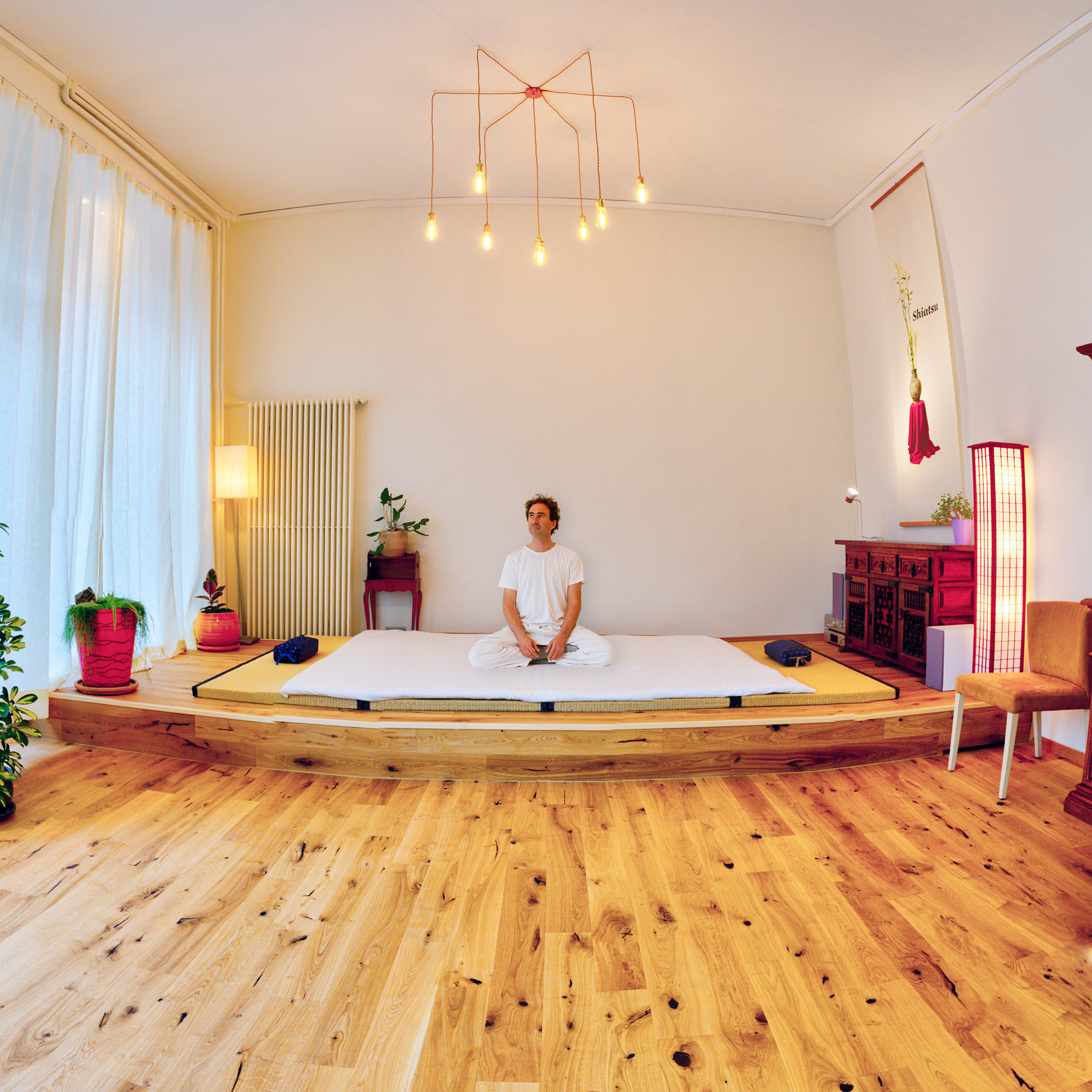
Shiatsu therapist for over 15 years, I currently practice in a therapy office based in Les Acacias. Sensitive to energy work, trained in fasciatherapy, craniosacral therapy and shin tai, I like to adapt each massage technique to my patients' needs.
techniques
- Shiatsu – Relieves tension and revitalises
- Shin Tai – Resolves trauma embedded in the spiral meninges
- Fasciatherapy – Releases connective tissue
- Geobiology – Helps understand the dynamics of energy in patients
- Craniosacral – Stimulates the circulation of cerebrospinal fluid
- Energy work – Removes subtle blockages
qualifications
- Organisation du monde du travail Thérapie complémentaire, Switzerland
Branch Certificate OrTra TC shiatsu – 2021 - International School of Shiatsu Kientalerhof, Kiental, Switzerland
Diploma in Shiatsu Therapy – 2012
continuing education
- Craniosacral and fascia for shiatsu, Brussels – 49 hours of continuing education (2025)
- Craniosacral therapy, Sète, France – 40 hours of continuing education (2023)
- Oligotherapy, Nyon, Switzerland – 16 hours of continuing education (2021-22)
- Shin Tai, Kiental, Switzerland – 96 hours of continuing education (2017-18)
- Iridology, Geneva, Switzerland – 24 hours of continuing education (2015)
- Fasciovisceral massage, Geneva, Switzerland – 24 hours of continuing education (2013)
pregnancy
Body Cushion equipment adapted for women
I welcome pregnant women up to the 9th month with cushions that allow them to lie comfortably on their stomach.
Shiatsu is very helpful for nausea, back pain, water retention, excessive fatigue, breastfeeding difficulties…
chair massage
Chair massage trainer from 2014-17
Within the company HP Formation, I taught courses with 24 hours of training per class.
On-site corporate chair massage
I travel to companies for seated shiatsu. For 5 to 20 people, offer your employees a personalised seated Shiatsu massage at their workplace.
At events (indoor or outdoor)
Celebrations, festivals, etc.
languages
- French – C2
- English – B2
- German – A2
- Italian – A2
in detail
presentations
I have been sensitive to the energy universe since the age of 10. I learned the basics of massage in a self-taught way, experimenting on myself and those close to me with touch techniques and energy regulation. At the same time, I completed vocational training in audio-visual electronics. The combination of energy work, the body and electronics allows me to draw parallels between scientific principles and others that appear less so.
discovering Shiatsu massage
In 2003, I discovered Shiatsu massage: a therapy derived from traditional Chinese medicine, combining energy care and massage, perfectly aligned with my interests and natural abilities. Graduated from the International School of Shiatsu in Kiental, German-speaking Switzerland, I opened my practice in 2009. Since then, I have taken additional training that allows me to vary my approaches in order to better identify and resolve patients' problems. Practitioner and Shiatsu therapist in Geneva since 2014, I also practice and teach chair massage.
a 6th sense
As a passionate Shiatsu therapist, a session mobilises my five senses, supported by a sixth: intuition. This approach guides each of my gestures and allows the patient to benefit from a fully personalised treatment adapted to the circumstances, whether expressed verbally or perceived through the body. This listening ability, applied throughout the treatment, allows the patient to confront their blockages and pain in order to overcome them, with the utmost respect for their limits. Each massage induces a deep and lasting relaxation that continues to affect the body for several days after the treatment.
Excerpt taken and adapted from the article « Adresses Incontournables » on the Figaro Madame website.
philosophy
Is a dream (desire or ideal) made of any kind of matter? At first glance, it seems intangible and uncontrollable. Yet sometimes it comes true. The realisation of a dream can take from a few moments to a lifetime. It often requires patience and tenacity. These are the main factors that allow a dream to become reality.
making your dreams come true
To understand the process of dream realisation, a description of the main stages is necessary. To do this, the metaphor of a drop of water forming and joining an ocean will help the imagination.
- The dream (a clear sky in which anything is possible): It is the junction point between the being and the rest of the universe. The lightest element of any living being, it has the ability to vary and adapt to changes in the person's position in relation to their extended environment, and changes in the environment in relation to the person.
- Imagination (the sky condenses and forms a cloud): Slightly denser than the dream, imagination is what connects thought with the dream. Always quick to change, it provides clear images of what the ideal final result could be.
- Thought (the cloud condenses and forms a drop): It is there to fix the imagination, capture the best image and work towards its realisation while adapting to the tangible conditions of the moment.
- Action (the drop falls and joins the ocean of reality): Directly influenced by thought, it is its continuum. It prevents external influences from disrupting its realisation. It is the junction point between the being and tangible reality.
These 4 stages influence each other: reality also influences the dream.
adapting your dream to the present
The ideal is for dream and reality to coincide. The drawback is that from the moment the imagination captures a dream and thought initiates the realisation process, the longer it takes to realise, the more the environment in which the dream was conceived is likely to change. Ultimately, the realisation may become incompatible with the new environment.
To maintain coherence between our dream and our reality, it is important that the 4 stages remain synchronised in their respective evolutions. Naturally, compromises must be made, and a great sensitivity must be maintained in order to know which of the 4 stages should be adapted in order to achieve your goal.
Once the dream is realised, its materialisation leaves our sphere of influence and joins universal creation. It remains to dream again and continue creating.
philosophy
Is a dream (desire or ideal) made of any kind of matter? At first glance, it seems intangible and uncontrollable. Yet sometimes it comes true. The realisation of a dream can take from a few moments to a lifetime. It often requires patience and tenacity. These are the main factors that allow a dream to become reality.
making your dreams come true
To understand the process of dream realisation, a description of the main stages is necessary. To do this, the metaphor of a drop of water forming and joining an ocean will help the imagination.
- The dream (a clear sky in which anything is possible): It is the junction point between the being and the rest of the universe. The lightest element of any living being, it has the ability to vary and adapt to changes in the person's position in relation to their extended environment, and changes in the environment in relation to the person.
- Imagination (the sky condenses and forms a cloud): Slightly denser than the dream, imagination is what connects thought with the dream. Always quick to change, it provides clear images of what the ideal final result could be.
- Thought (the cloud condenses and forms a drop): It is there to fix the imagination, capture the best image and work towards its realisation while adapting to the tangible conditions of the moment.
- Action (the drop falls and joins the ocean of reality): Directly influenced by thought, it is its continuum. It prevents external influences from disrupting its realisation. It is the junction point between the being and tangible reality.
These 4 stages influence each other: reality also influences the dream.
adapting your dream to the present
The ideal is for dream and reality to coincide. The drawback is that from the moment the imagination captures a dream and thought initiates the realisation process, the longer it takes to realise, the more the environment in which the dream was conceived is likely to change. Ultimately, the realisation may become incompatible with the new environment.
To maintain coherence between our dream and our reality, it is important that the 4 stages remain synchronised in their respective evolutions. Naturally, compromises must be made, and a great sensitivity must be maintained in order to know which of the 4 stages should be adapted in order to achieve your goal.
Once the dream is realised, its materialisation leaves our sphere of influence and joins universal creation. It remains to dream again and continue creating.
symbolism of the moment
What precedes can be seen as a succession of moments intertwined with one another. The duration of a moment can vary according to one's perception and experience. If we take the case of a difficult situation such as separation, illness, bereavement or moving house, the sudden change between the starting state and the arrival state will happen nonetheless, moment by moment. Each of these moments has its own quality (emotional, sentimental, physical, mental), but some will mark the change more than others.
navigating transition
In practice, "unmoment" symbolises our passage from one state to another. It can be the one that leads to relief after suffering, but above all it is the one that will lead to the liberation of a burden carried for too long. Becoming aware of this segmentation means defining the key moments between changes of state, then working to reunite them in order to restore the uninterrupted continuity of individual experience towards a broader, universal, borderless experience – whether internal or external.
here, now
"unmoment" represents the moment we ideally live perpetually, breath after breath, without interruption or interval arising from a before or an after projected by the activation of our memory. It is the sensation of eternity in the present moment, it is the total and permanent openness that plunges consciousness into its sanctuary, where the last illusion of all the states that make up our being disappears to make way for unity, emptiness, true peace.
All this is illustrated by the practice's logo: a drop, an ocean and the point of contact.
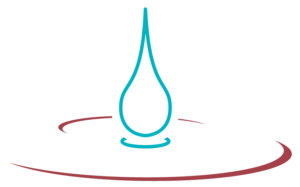
If we break down the image in space and time, we can see 3 distinct images:
- First the drop, born from a succession of causes giving it its present form (see above "philosophy").
- The point of contact is the place and the moment that will be touched by the drop.
The new environment in which it will dissolve to give birth to a new reality, far from the trappings of the past and still untouched by the dreams of the future. - The waves, which represent the continuation of realisation in the new environment.
In this philosophy, the drop represents a vertical movement (timeless and qualitative) and the ocean a horizontal plane (temporal and quantitative). In reality, the drop "falls" indefinitely into a multitude of planes of reality. It will be the qualities of the drop that define what it projects into the ocean at instant "t".
outside space and time
The moment that will be worked on in a session will be that of the point of contact between the drop and the water surface. This moment outside of space and time can be approached mentally in the following way: imagine that the drop and the plane are made up of the same water molecules. You can see them on the lower part of the drop and on the contact plane as a continuous chain. If we get close enough to the moment when the drop and the plane are almost touching, it is impossible to differentiate the molecules of the drop and the plane. We can say that they are simultaneously in contact and undifferentiated. Yet the drop and the plane still have their distinct shape but, potentially, they are already one.
aligning everything within yourself, therefore outside yourself
It is precisely this moment that is sought, where past and future merge in the present and everything becomes possible. One could even say that, with the present moment taking up all the space, the past, the future and all divergences merge. This is where body and mind meet, this is where the energy centres align, this is where we become one with the universe in all its infinity.